
In today’s competitive and data-driven business environment, understanding consumer behavior has become more complex than ever. Traditional research methods such as surveys and interviews often capture what consumers say, but not necessarily what they feel or subconsciously experience. Neuromarketing, which combines neuroscience with marketing and behavioral science, is transforming this landscape by providing scientific insights into how consumers think, feel, and make decisions.
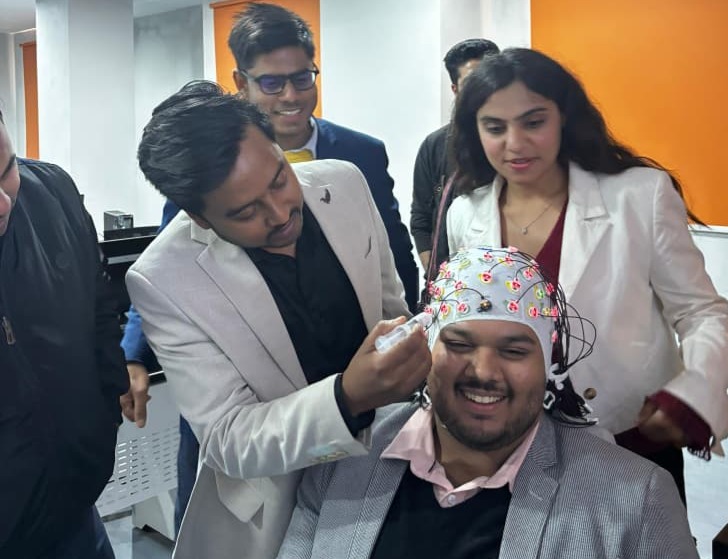
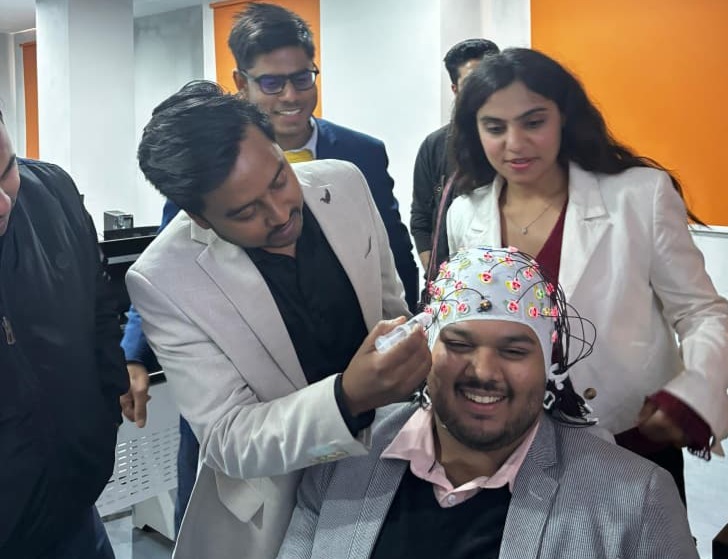
To introduce this emerging field and its practical applications, Jaipuria Institute of Management, Jaipur organized a Certification Course on Applied Neuromarketing & Consumer Neuroscience. The workshop was designed to provide participants with a structured introduction to neuromarketing concepts, neurophysiological tools, and their applications in consumer research and marketing strategy. It aimed to build conceptual clarity on how brain functioning influences attention, emotions, and decision-making, and how these insights can be used to improve marketing effectiveness and consumer experience.
The workshop provided participants with exposure to advanced neuromarketing tools such as Electroencephalography (EEG) and eye-tracking, which are used to measure brain activity and visual attention in real time. These tools help researchers understand consumer engagement, emotional responses, and cognitive processing with greater accuracy and objectivity. The sessions also introduced participants to experimental design, data acquisition, and introductory analysis techniques, enabling them to understand how neuroscientific methods can be integrated into behavioral and marketing research.
By combining theoretical learning with practical demonstrations, the workshop highlighted the growing importance of neuroscience in modern marketing. Participants gained insights into how neuromarketing can be applied to evaluate advertising effectiveness, enhance brand strategy, improve product design, and create more engaging customer experiences. The program also encouraged interdisciplinary learning by bringing together participants from management, marketing, and behavioral science backgrounds, reflecting the evolving nature of marketing research.
As businesses increasingly rely on data and scientific methods to guide strategic decisions, neuromarketing is set to become a key driver of marketing innovation. The ability to objectively measure consumer attention, emotions, and decision processes will help organizations design more effective marketing strategies and meaningful customer experiences. With growing adoption across academia and industry, neuromarketing represents the future of consumer research—where marketing decisions are informed not just by opinions, but by direct insights from the human brain.
 Jaipuria Talks Blog